
The mountains of Nepal
If you are a windows user, you will notice that your laptop’s lockscreen wallpaper changes everyday to reflect a beautiful sight of nature. Chances are that one of those wallpapers have been those of the Himalayan mountain ranges, but you would probably just have taken a quick look and signed in anyway to work on your presentation in Google Drive that your teammates are appearing online on but not contributing to. I have had the fortune to personally get a quick glimpse of those sights and it was like being on another planet altogether. I made this trip with my NDU friends from the 21st December to 29th 2016. How the idea to visit Nepal came about, I have all but forgotten, but all I knew was that it was certainly going to be an interesting trip. Some of us led the communication with a guide in Nepal known as Dendi, who planned the entire trip for us and settled all of the administration needed to access the mountains. Following that, we booked our flights and prepared to make the mindboggling dilemma of choosing to go light or pack in extra warm clothing. Without a doubt, I decided to go the minimalist route and opted for only a pullover and a thin cotton jacket as my form of thermal protection. I managed to stuff all of the clothing needed for an entire week into a single relatively huge backpack that I could carry on my shoulders and was rather proud of it
Arriving in Kathmandu
We arrived in the capital of Nepal in the late afternoon at Tribhuvan national airport, which was the most rudimentary airport that you could ever hope to expect in a city’s capital. We were only supposed to meet Dendi on the following day so we had the whole afternoon and evening to ourselves to explore Kathmandu. We were lodged in what I would describe as a motel-like place operated by monks. The rooms were lacking of any form of luxury but it does serve its purpose. After all, we chose the budget option of the travel. We spent most of the first day exploring the a temple, taking pictures, and having a rooftop dinner at a random restaurant. The fare wasn’t as cheap as I thought it would be, but being tourists we weren’t privy to the cheaper spots and was probably eating at their equivalent of a 3 star restaurant. The food was only fair but we probably weren’t ordering the right dishes anyway. So much so for being tourists.
We had a good sleep and proceeded to meet Dendi to begin our introductions. He invited us to his house at the outskirts of the city along with the other porters so that we could bond over a meal cooked by his family. He was a relatively tall, middle aged dark-skinned man who was warm, hopsitable and polite, good traits to have considering that we were going to put our lives in his hands over the next week. He had planned for us a 5 day hike route through the mountains, passing through Ghandruk village, which was the home of the Gurkhas, a part of our police and military force on our home soil, culminating on the peak of Poon Hill, which was slightly north of 3000m above sea level. He described Poon Hill as a place where children would go to on the weekends, which did not really make me feel like a man at all. However, we only had a week to trek and thus could not engage on manlier hikes like the Annapurna Base Camp hike which would require a 10 day commitment. We had a nice meal and went back to our hostel to rest. We would need alot of it since we had to wake up before dawn and get loaded up on to a minibus that would bring us to another town much closer to the mountains.
Beginning the hike
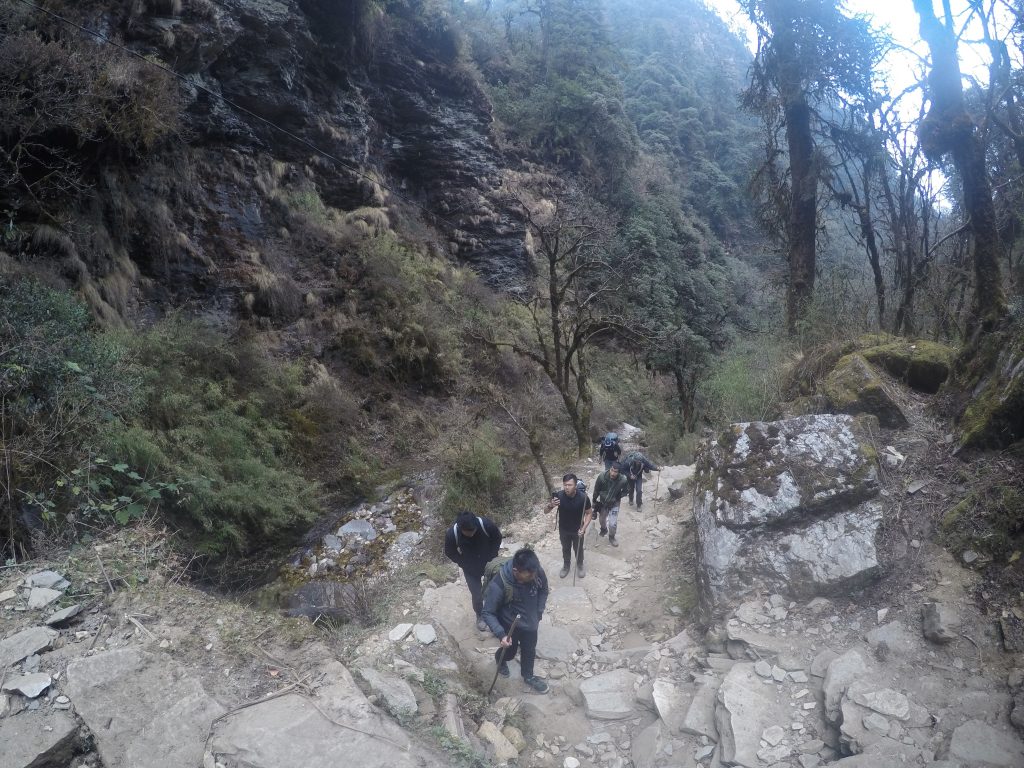
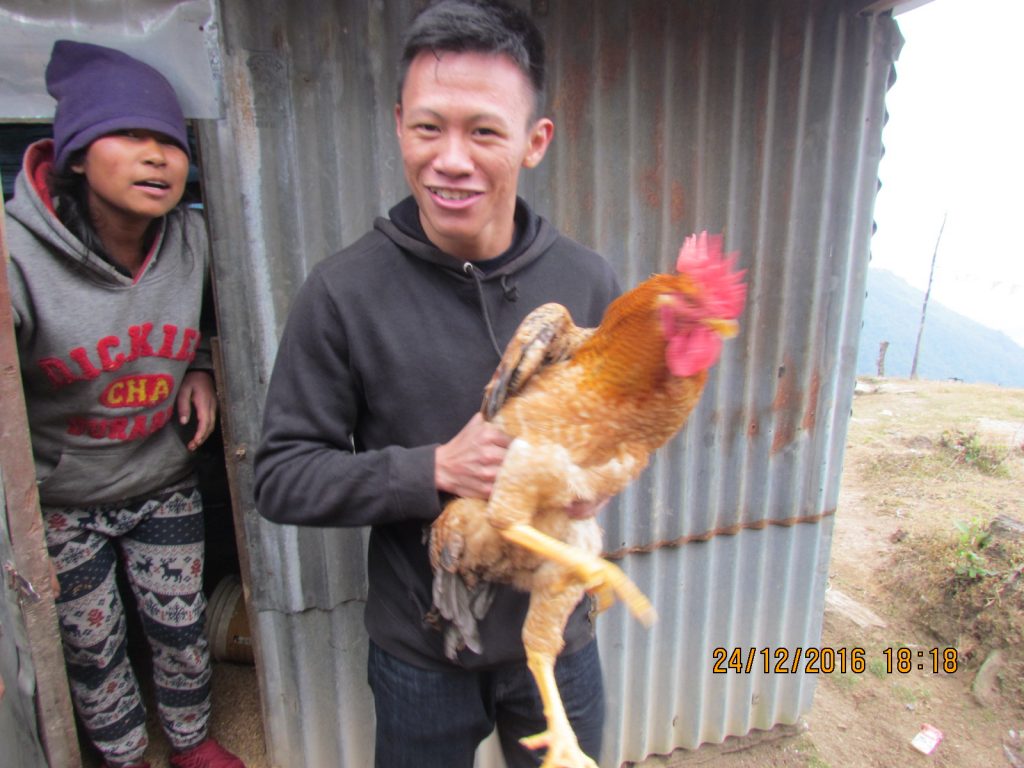
We began our hike proper via a small path by the side of a mountain. It was just an assuming set of steps carved into rock, but we began our 5 day ascent from there. What was initially euphoria at being able to begin the hiking part of the trip would soon give way to tiredness and fatigue. While most of the others chose to engae the porter to carry their additional luggage and brought about only a light day pack containing essentially supplies, I opted for a more rudimetary option and decided to carry my bag on my own, especially since it was just a single backpack. The porters on the other hand, were lugging up to 40kg to 60kg of weight unto their bodies. They were not tall nor muscular, but they certainly could move loads uphill like no other. It was probably a combination of years of hard work combined with their genetic superiority that gave them this superhuman ability. After all, moving weights across different villages across the mountains seemed the be a daily neccessity in this part of the world. It was probably a way of life for them and how they made their living. It was certainly a very different way of life compared to ours when the only load we have to put on is the useless knowledge that we digest and regurgitate at our institutions. After about 4 hours of ascending, we could already see the snow capped mountain border the entire horizon, the sun’s golden rays reflecting off the white snowy peaks. The first day’s trek ended somewhere around 4pm, and we put up in a guesthouse overlooking the edge of the mountain, which was pretty beautiful. But the highlight of the night was our decision to include chicken in our dinner, which meant that we had to slaughter one from the coop given that there were no such things as supermarkets in those mountains. I even had the pleasure of holding the bird just 30 minutes before its final moments. We watched as they chopped off its head and plucked its feathers. While it seemed like a novelty to us, it was probably a way of life to them and probably nature’s way as well. We enjoyed the night sky with its stars as well, although most of our efforts at trying to capture it through a camera failed. We woke up pretty early the next day to catch the sunrise as well before setting off on another long series of ascents.
Most of our hiking was done on uneven steps made up of rocks and mud winding across the gradient. The first 2 days were more brutal because we were still ascending upwards, and there were indeed times when we were close to panting. But we did make a good pace and we looked forward to all the little breaks and stops along the way. Our meals were usually held at little taverns that usually doubled up as guesthouses, and there were almost always the same fare : Daal baht. Daal Baht was basically rice (A whole lot of it), pickled vegetables, and a generous dollop of curry with bits of potato and other vegetables. There were some variations in the vegetables and curry used but not much. During the first few days, we really looked forward to the meal, after all we were usually starving and fatigued after lunch from all the climbing, and I would admit its a pretty good refueler. I usually ate up to 2-3 bowls of rice per meal, similar to the porters as I wanted to emulate their lifestyle to a certain extent. The temperature was cool in the afternoon despite it being in December and so no outer layer was really needed. The temperature would fall rapidly once the sun set though, and it was very chilly in the evenings as well as the wee hours of the morning. We settled into a steady rhythm, up and down up and down, all the while with picturesque mountains set in the horizon looming over us. Dendi was kind to explain to us the names of the mountains, and we struggled to pronounce it in their native tongue. We moved from rest house to rest house, each time refuelling with daal baht and cold water. Strage enoguh, some of these rest houses featured products that you would normally associate with not only Nepal, but a village on Nepal’s mountain ranges. I was surprsied to find Korean instant noodles as well as potato chips, items that belonged in a city and not on a mountain range. It seems that they have become commercialised to a certain extent and have certainly modified their services to accomodate the affluent, as opposed to servicing just local porters going about their daily lives. There was even wifi accsess in some of the villages. Sure it was slow as hell and struggled to even load whatsapp messages, but how they got the connection in the first place is still a marvel that I am yet to comprehend.
Reaching Ghandruk Village
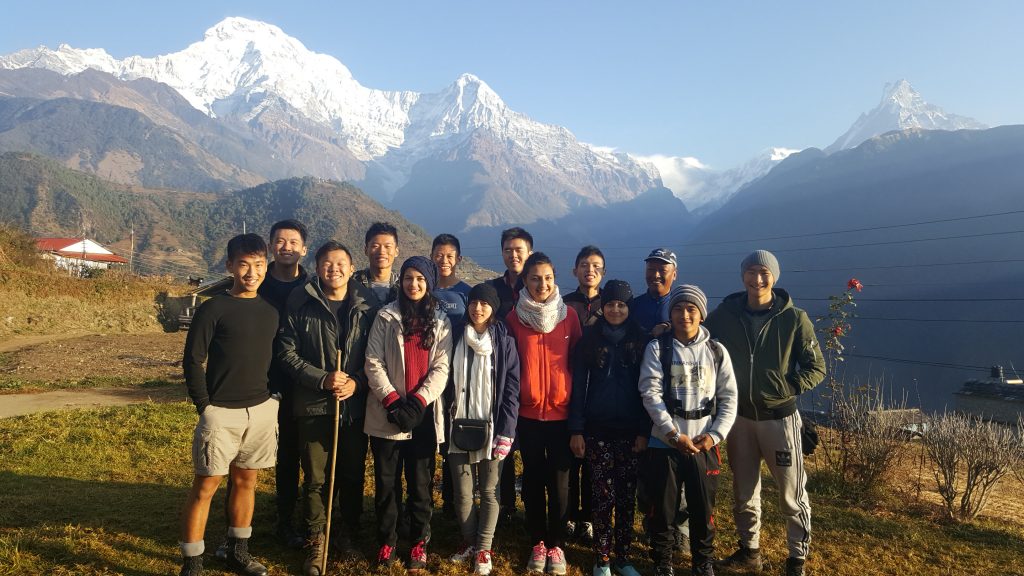
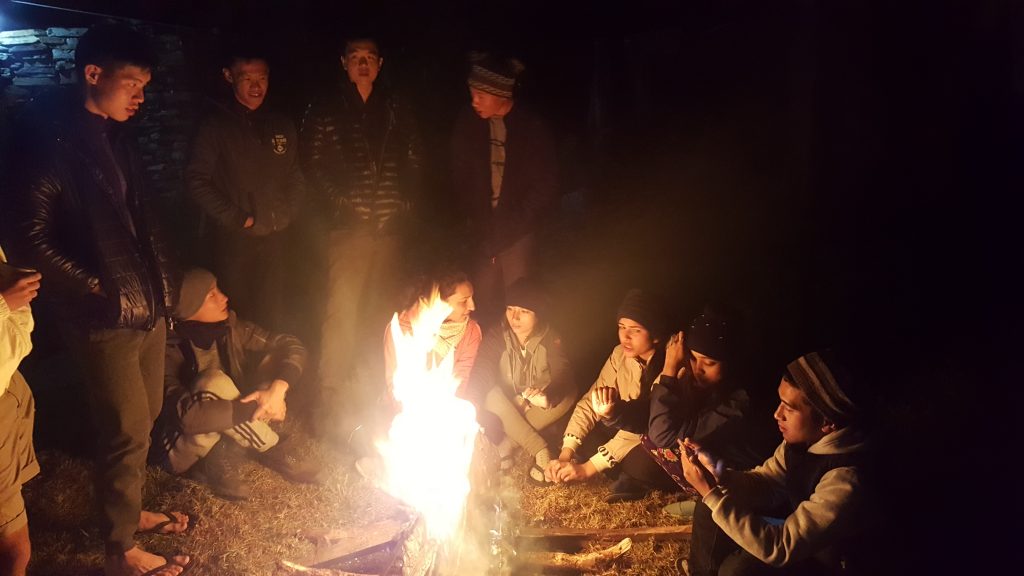
Fortunately we still put up a good pace according to Dendi, and within the 3rd day we arrived in Ghandurk, which was a sprawling expanse of houses spread over quite a large area. This was the home of the Gurkhas indeed, which was one of Singapore’s divisions in the police force. I found it strange that many of their inhabaitants were now living less than 3km away from my actual home in Serangoon,and here I am in their homeland over 4000km away. We set about walking through the village and partaking in some cultural activities like visiting their museum and looking at their relics. The highlight of those relics was of course a Gurkha knife or kukri, which was an important heirloom in their families. Some of us set about trying to obtain one and we went about the village looking for sellers. Dendi helped with this process and tried to determine the authenticity of some of the blades. 2 of my friends managed to get their hands on those prizes, which I believe would now become a heirloom of their family, which is good since Singapore families usually only have 4 room HDB flats as heirlooms. We stayed in Ghandruk overnight and celebrated Christmas the next by taking off our shirts in the cold while wearing a Santa hat that we carried all the way from Singapore. During one of the nights in a village, the villagers made a campfire and we all gathered around it. They taught us some sort of dance and we went along with it as well.
Ascending Poon Hill
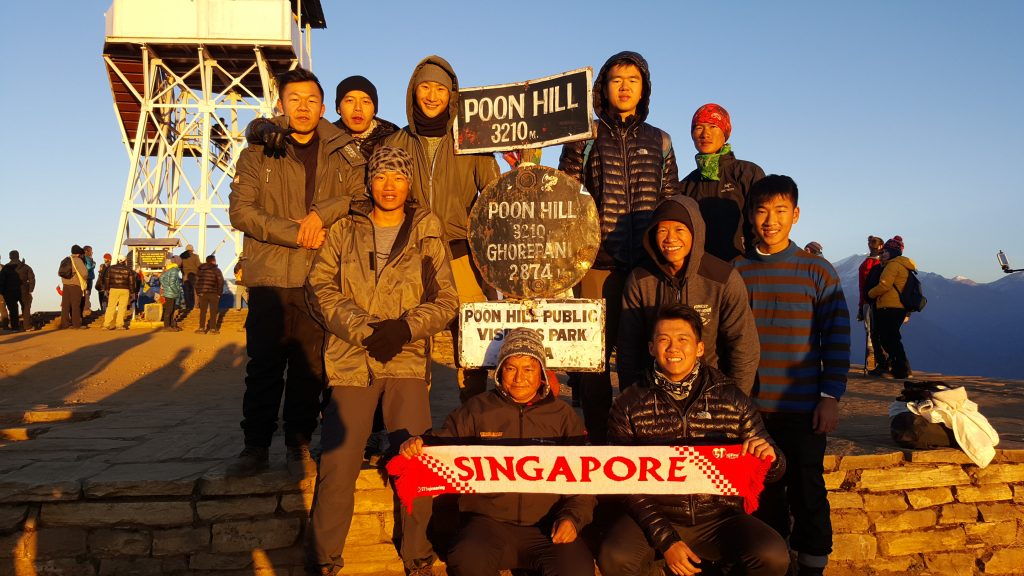
We were scheduled to make the trip up to Poon hill, which was basically the highlight of the trip, on the 5th morning of our hike. Since we wanted to see the sunrise over the magnificent mountains, we had to get up at about 430 or 5am in to make it. It was still deathly cold and we were all pretty tired, but we still had to make this journey. We stumbled about in the dark, using flashlights to guide our way and eventually made our way to the entrance to the final the trek up. It was actually crowded, both with locals and other foreigners, who were probably engaged in similar itineraries. The peak of poon hill itself offered nothing much, but you could have a nice unobtstructed view of the surrounding landscapes and the mountain ranges with its magnificent snow peaked caps. Most of the time was spent waiting for the multitude of other tourists to get their photo taken at the Poon Hill altitude marker. At this point the hard part was now over for good and what was left was to the descent down. We wered offered two choices by Dendi, to pay about $15 SGD to take a jeep back down to the bottom of the mountain, or make a 5 hour trek down. Needless to say, we were all pretty worn out by then and decided to take the jeep like the entitled millenials that we were. It was then that we knew that the climbing part of the journey had come to a sweet end. We managed to see all that we had come to see, and no mishaps happened along the way.
Goodbye for now
We stayed a night at a nearboy town and took a minibus ride back to Kathmandu back to the hostel the next day. Back in Kathmandu, we went to a pashmina seller, which was touted as the best scarf in the world, its brand name replicated unsuccessfully by thosuand of imitations all over the world. The sellers boasted that any other scarfs proclaiming the “pashmina” material over the world is false and that theirs is the true Pashmina. They told us that it was made from the beard of goats, and thus was extremely rare and soft. I am unsure of how much of that story is fact or fiction, but when I touched the scarf, it was unlike anything that I have ever felt before. It had a certainly quality of softness that cannot be described with just words.I was so blown away by the quality so I bought 2 scarfs which cost about $25SGD each for my mum and my grandma back home as a gift. After that, since it was going to be our last night, we spent it eating a meal at Dendi’s place while we went over the memories of the journey.
Overall, it was quite a really well planned trip, both in terms of pace, route and budget. Sure most of the meals that we got were almost exclusively vegetarian, but it was justified given that we were only paying about $1,000 per person to be very well taken care of for the entire journey. It was a pity that we couldn’t do the Annapurna Base Camp trek, wose views would probably eclipse those on this trip. It was still a great journey and definitely one of the cooler countries that I have travelled to and I believe everyone should definitely try it out sometime in their lives as well.
Photo Credits are to Jack and Gabriel!